
Map Navi KOYASAN
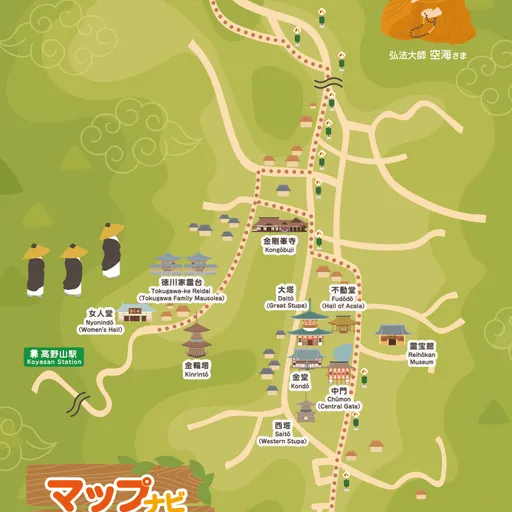
Visit 12 historic sites, including the Daimon Gate and Okunoin, and use VR on your smartphone to view temple interiors that are normally closed to the public. Discover the world of prayer and the teachings of Kukai that dwell beyond the scenery before your eyes. We invite you to fully immerse yourself in the true essence of a faith that has endured for 1,200 years.
 Posted by株式会社サビアUpdated:
 All spots information
12 spots
 Gates & Spiritual Boundaries
Daimon (Great Gate)
Gates & Spiritual Boundaries
 Open
Open
The Daimon, or “Great Gate,” marks the main entrance to Kōyasan. This function was originally carried out by a torii gate located several hundred meters below the current location (in a place called Tsuzuraoredani). However, in 1141, the original Shinto-style gate was replaced by a Buddhist-style entrance. Less than a century later, in 1230, it was rebuilt as a two-story tower gate (rōmon) with five bays, similar to the one now standing today. Over the centuries, the Daimon has been repeatedly destroyed by fire and rebuilt. The current reconstruction, which is classified as an Important Cultural Property, dates to the year 1705. Address 〒648-0211 Koyasan, Koya-cho, Ito-gun, Wakayama Google Map Check with Google Maps Business Hours Phone Number Admission Fee Regular Holiday Access Parking Official website https://www.koyasan.or.jp/ SNS
Chūmon (Central Gate)
Gates & Spiritual Boundaries
Open
The Chūmon, or “Central Gate,” is the formal entrance offering symbolic protection to the Danjō Garan. A gate of some kind — possibly a Shinto-style torii — stood at this spot as early as 819. According to tradition, the first Buddhist-style gate was erected by Kūkai’s younger brother, Jitsue (786–847), sometime after Kūkai’s entrance into eternal meditation in the year 835. Address 〒648-0211 132 Koyasan, Koya-cho, Ito-gun, Wakayama Google Map Check with Google Maps Business Hours Phone Number Admission Fee Regular Holiday Access Parking Official website https://www.koyasan.or.jp/ SNS
 Pagodas & Sacred Halls
The original Kondō was built in 819 as a lecture hall (or kōdō) where Kūkai could instruct his disciples in esoteric teachings.The current Kondō is a reconstruction completed in 1932. Today, as the collective worship hall for all of Kōyasan, the Kondō serves as the setting for many of the most important rites and ceremonies conducted throughout the year. Address 〒648-0211 132 Koyasan, Koya-cho, Ito-gun, Wakayama Google Map Check with Google Maps Business Hours Phone Number Admission Fee Regular Holiday Access Parking Official website https://www.koyasan.or.jp/ SNS
Daitō (Great Stupa)
Pagodas & Sacred Halls
OpenConstruction of the original Daitō began in the year 819 and took more than fifty years to complete. It was the central building included in Kūkai’s vision for the Danjō Garan, which was conceived as a physical mandala uniting the two worlds of Shingon Esoteric Buddhism. In this design, the Daitō represents the Taizōkai, or “Womb Realm,” with the Saitō representing the Kongōkai, or “Diamond Realm.” The Daitō we see today is a reconstruction completed in 1937. Address 〒648-0211 132 Koyasan, Koya-cho, Ito-gun, Wakayama Google Map Check with Google Maps Business Hours Phone Number Admission Fee Regular Holiday Access Parking Official website https://www.koyasan.or.jp/ SNS
Saitō (Western Stupa)
Pagodas & Sacred Halls
OpenAlthough completed in 887, after Kūkai’s passage from this world, the first Saitō, or “Western Stupa”, was an important part of his original design for the Danjō Garan conceived as a counterpart to the Daitō. In tandem, the two stupas were created to give three-dimensional form to the two mandalas (the Dharma Realms of Mahāvairocana) central to Shingon Esoteric Buddhist doctrine. Address 〒648-0211 132 Koyasan, Koya-cho, Ito-gun, Wakayama Google Map Check with Google Maps Business Hours Phone Number Admission Fee Regular Holiday Access Parking Official website https://www.koyasan.or.jp/ SNS
Fudōdō (Hall of Acala)
Pagodas & Sacred Halls
OpenThe Fudōdō is one of the oldest surviving structures at Kōyasan, dating back to the year 1198 when it was built by the holy man Gyōshō (1130–1217) at the request of Princess Hachijō-in (1137-1211), a daughter of Emperor Toba. Regarded as a remarkable example of aristocratic residential Heian-Era architecture, it has been designated a National Treasure by the Japanese government. Address 〒648-0211 338 Koyasan, Koya-cho, Ito-gun, Wakayama Google Map Check with Google Maps Business Hours Phone Number Admission Fee Regular Holiday Access Parking Official website https://www.koyasan.or.jp/ SNS
The Kinrintō, or “Golden Wheel,” pagoda is said to be the mausoleum of the senior priest Meizan (1021-1106) who was responsible for the restoration of Kōyasan after a period of decline during the mid Heian Era. Address 〒648-0211 690 Koyasan, Koya-cho, Ito-gun, Wakayama Google Map Check with Google Maps Business Hours Phone Number Admission Fee Regular Holiday Access Parking Official website https://www.koyasan.or.jp/ SNS
Nyonindō (Women’s Hall)
Pagodas & Sacred Halls
OpenUntil the year 1872, women were prohibited from entering the sacred precincts of Kōyasan, but this did not prevent many female worshippers from climbing the mountain to get as close as they were allowed to its holy places. To accommodate these pilgrims, facilities known as nyonindō, or “Women’s Halls,” were established outside the boundary of the sacred area. These buildings functioned as religious lodgings (sanrōjo), where women could stay for a period of time to pray and practice their devotions. Because they were barred from crossing the ritual boundary, women worshipped from afar, directing their prayers toward the sacred sites within. Address 〒648-0211 709 Koyasan, Koya-cho, Ito-gun, Wakayama Google Map Check with Google Maps Business Hours Phone Number Admission Fee Regular Holiday Access Parking Official website https://www.koyasan.or.jp/ SNS
 Mausoleums & Holy Sites
Tokugawa-ke Reidai (Tokugawa Family Mausolea)
Mausoleums & Holy Sites
OpenThe Tokugawa Family Mausolea were erected in 1643 on what was then the grounds of Daitokuin Temple. From the Muromachi Era, this temple had maintained a protective partnership with the ancestors of the Tokugawa clan. The mausolea were established by the third Tokugawa Shogun, Iemitsu, to honor the memory of his grandfather and father. Only two of the three original sanctuaries remain. Standing side-by side, each measures 5.45 square meters and features a single roof in the “tented-roof” (hōgyōzukuri) style. The sanctuary on the right, identified as The Mausoleum of Tōshōgu Ieyasu honors the deified founder of the Tokugawa Shogunate, Tokugawa Ieyasu (1543-1616). The one on the left, which is simply called The Spirit Hall of Hidetada, enshrines Ieyasu’s son Tokugawa Hidetada (1579-1632). A third structure, which formerly stood at the eastern end of the compound, housed the mortuary tablets of other members of the three Tokugawa houses. It was destroyed by fire in 1888. Address 〒648-0211 682 Koyasan, Koya-cho, Ito-gun, Wakayama Google Map Check with Google Maps Business Hours Phone Number Admission Fee Regular Holiday Access Parking Official website https://www.koyasan.or.jp/ SNS
 Temples & Cultural Treasures

In the year 816, when Emperor Saga (786-842) granted Kūkai permission to establish his monastery at Kōyasan, the name given to the entire complex was Kongōbuji, which literally means, “Temple of the Diamond Peak.” This name was derived from a sutra known as the Kongōbu rōkaku issai yuga yugi kyō (or “Sūtra for Yogins on the Complete Yoga of the Vajraśekhara Palace”). It is thought that this name was chosen in order to reflect Kūkai’s desire to establish a center where the teachings of esoteric Buddhism would flourish and endure eternally, with the durability of a diamond. Address 〒648-0211 132 Koyasan, Koya-cho, Ito-gun, Wakayama Google Map Check with Google Maps Business Hours Phone Number Admission Fee Regular Holiday Access Parking Official website https://www.koyasan.or.jp/ SNS
Reihōkan Museum
Temples & Cultural Treasures
OpenThe Reihōkan Museum was established in 1921 to house the many important cultural properties at Kōyasan. It was founded by Kongōbuji Temple through the contribution of numerous voluntary donors. The main edifice constructed at this time is organized around two main exhibition rooms connected by corridors to create a gallery-style exhibition complex. The first of these rooms is known as Hōkōkaku, or “Radiant Light Pavilion.” The second, and primary space is the Shiunden, or “Hall of Purple Clouds” – a reference to the trail of violet clouds that conveyed Kūkai’s vajra from China to Japan according to the legendary account of the foundation of his monastery. In 1998, the building itself was recognized as a valuable example of Taishō-Era architecture and designated as a Registered Tangible Cultural Property by the Japanese government. Address 〒648-0211 306 Koyasan, Koya-cho, Ito-gun, Wakayama Google Map Check with Google Maps Business Hours Phone Number Admission Fee Regular Holiday Access Parking Official website https://www.koyasan.or.jp/ SNS
Okunoin (Kyōzō / Sutra Repository)
Temples & Cultural Treasures
OpenBuilt adjacent to the east side of the Gobyo (Mausoleum) where Kobo Daishi entered eternal meditation, this kyōzō (sutra repository) was donated by Lord Ishida Mitsunari. The interior features an octagonal, rotating rinzō (sutra wheel) with the main image, a statue of Monju Bosatsu (Manjusri) riding a lion (now housed in the Reihōkan Museum), enshrined at the front, and it once held the Goryeo edition of the Issaikyō (Complete Buddhist Scriptures). Furthermore, the entire structure is richly colored, and together with the carvings on the kibana (decorative beam ends), it showcases the distinct stylistic features of the Momoyama period. Address 〒648-0211 550 Koyasan, Koya-cho, Ito-gun, Wakayama Google Map Check with Google Maps Business Hours Phone Number Admission Fee Regular Holiday Access Parking Official website https://www.koyasan.or.jp/ SNS